Navigation Pages

| HOME | SHOP | TRAVEL | FASHION |

Showing posts with label asia. Show all posts

Sunday, August 14, 2011

Calamian: On Broken Wings


Day 17: Puerto Princesa - Coron (Busuanga)

After breakfast, we slowly packed our bags for our flight from Puerto Princesa to Busuanga Island. The airport is just about 10 minutes away with the tricycle, but Leo shuttled us on the hotel's van. It was also free of charge.

Fortunately, I was able to check my email the day before and learned that our flight (via Air Phil Express) to Busuanga Island was rerouted via Manila, and in Manila, we had four hours to kill. I didn't mind the detour since the new airport was kind of cosy. There are restaurants, cafe and shopping opportunities inside the airport terminal.


When we checked in, the girl at the counter had a tough time figuring out how she would enter our flights into her computer. Since we were retoured, we had to fly to Manila then to Busuanga instead of going directly from Puerto Princesa to Busuanga. It took like ca. 45 minutes (I've timed it.) When she finally figured it out, she told us that our luggage is 3 kilos overweight and that we had to pay twice (apparently for 2 flights PPC- MLA, MLA-BUS). I don't mind paying the 3 kilos extra, but I was kind of thinking that since she held me up for a long time that at least they should forget the extra kilos. I told her that it was not my fault they have to reroute us since our original booking was a direct flight and I will pay the 3 kilos excess baggage once. It took a few more minutes until she was able to resolve it. Then I had to queue again to pay the airport tax until we would eventually be admitted to the waiting area.

As I have expected, our flight was delayed for over an hour without any explanations from the airline. Eventually, we were able to take off and landed in Manila after less than an hour. At the domestic airport in Manila, we took our lunch at two different restaurants due to our different choices of food and walked around a bit and got cash due to not being sure of any ATM in the islands. There was actually just a little time left due to previous delays, so we had to check in again. I didn't know that we only had to show the airport tax receipt since it was a connecting flight, so we ended up paying the airport tax again.


The flight to Busuanga island was again delayed due to a low-pressure area somewhere in the Visayas where our plane to Busuanga originates. Again, it was uncertain as there was no real explanation from the airline. We finally had been able to get on our flight after another hour and landed at the Francisco Reyes Airport in Busuanga island. It was a small but serviceable airport. Vans were waiting outside to take the passengers into town which is about 30-45 minutes drive on a good paved road. We arrived at our hotel at 16:00 (4:00 p.m.).


Wednesday, August 10, 2011

El Nido: Big Lagoon, Small Lagoon

Day 13: El Nido - Puerto Princesa

El Nido is a small little pleasant town with many small streets. It has an established tourist infrastructure, but unfortunately, there is still no ATM (machine), so we brought enough cash to be on the safe side. As far as I've heard that the local government is gearing towards getting more tourists to come. There was even a plan to dredge out the bay for bigger ships to dock but the locals disapproved of the plans and eventually, it got shelved. Many people, however, has been talking about making it the next Boracay. I personally have nothing against development, but the locals should be careful on what types of tourists and tourism activities they wanted to attract. It needs a lot of careful planning to make it sustainable and keep it green.

Contrary to what people have heard, it is still quite affordable to visit there. The high-end resorts are mostly located on the islands around Bacuit Bay. 


We woke up at 7:00 o´clock the next morning and immediately launched to our much-awaited island hopping tour along with my friend Daisy and her two colleagues. We rented a boat for 2,500 Pesos, and we had it for ourselves; we are at liberty to island-hop at our own pace. Our boatman docked just right next to our hotel. First off, we went to the Big Lagoon, Small Lagoon, Secret Lagoon and Miniloc Island to snorkel. Everything is fantastic – the subaquatic biosphere, the limestones and the beaches. The colourful fishes came and kissed my legs esp. when we fed them with bread. Then we went to Simisu Island where we stayed a bit longer to snorkel and feed more fishes.


We decided we all had enough, so we asked our boatman to take us back to town. We wanted to get back to Puerto Princesa not so late, so off we drove after getting some lunch at a small eatery. We arrived around 17:30 (5:30 p.m.) and checked-in again at our favourite hotel, the Hibiscus Garden Inn.

I called up my nephews to pick us up from our hotel and took us to Golden Valley which is about 20-30 minutes tricycle ride from town. The trip around town gave us another glimpse of the city and city life where a regular tour would not afford. We stayed just briefly at my eldest sister’s place to give some gifts. Then off again to the second sister and did the same. We were so tired from the long drive from El Nido. Back to the hotel, my friend was so beat up and decided to just rest while I went out to meet a good friend of mine, Teng of Palawan Today, for dinner at Neva’s Place. It was a short sleep and up again at 5:30 a.m. to go to the world heritage site, Puerto Princesa Underground River.


The Municipality of El Nido is composed of 18 barangays (villages) covering a total land area of 50,000 hectares. Its population of 27,000 people is a combination of native Palaweños, with a heavy presence of migrants from other parts of the Philippines. The world's largest pearl was discovered by a Filipino diver in a giant Tridacna (mollusk) under the Palawan Sea in 1934. Known as the "Pearl of Lao-Tzu", the gem weighs 14 pounds and measures 9 1/2 inches long and 5 1/2 inches in diameter. As of May 1984, it was valued at US$42 million. It is believed to be 600 years old.

Tuesday, August 9, 2011

El Nido: Talindak, Bacuit

Day 12: Puerto Princesa - Taytay - El Nido

 Welcome to El Nido!
The town traces its roots from a small Tagbanua village called Talindak. Some time in the 16th century, waves of migrants from Cuyo Islands came here to settle. In the 1800s, the Spaniards arrived, and they moved to the part where the present-day Población and Mabini are located. The first Spanish families were the Canovas, Vázquez, Ríos and Rey. In 1890, the Spaniards renamed it as Bacuit. At the time, the center of the town was Cabigsing, then known as Inventario. Chinese families moved into the area about the same period, first settling in Langeblangeban. The first Chinese settlers were named Lim, Chin, Liao, Edsan, Ambao, Que-Ke, Lim Piao, Yu His, Pe Phan and Pe Khen.


We arrived in El Nido around 12:30 p.m. after being on the road for nearly six hours. We immediately took a short break at the view deck before heading to the town proper. The viewing platform already presented us the fantastic view of beautiful beaches and clear blue sea, the mountains and greenery. Upon arrival at the town centre, our travel companions suggested the Marina Garden where we immediately got a room. It's located directly next to the beach.


The room costs 1900 pesos or about 33 €. We were a little disappointed. The room was in the new part of the hotel, and it was clean, but it somehow looks a bit shabby. Some small things like wobbly headboard, a loud air conditioning unit, (re. the electric power is only from 4:00 p.m. till 12:00 midnight) no fridge or TV (a fridge would have been good since we love to keep some cold drinks) and a rather small and uncomfortable bathroom. We had to fill the bucket for flushing the toilet. And since there was no electricity, the bathroom was too dark.  Our companions opted for the more basic room at the "native cottages". Maybe a plus was it's proximity to the beach as well as the town centre. There are numerous hotels in El Nido and in almost every price category. I've been to another hotel on previous trips, and theirs are also very acceptable. Next time I'll be in town, I would probably prefer to try another one.


Towards the end of the day, we decided to take a stroll at the tidal flats since it was low tide. My friend who grew up in an urban Europe found it very fascinating. I grew up in a similar environment like in El Nido, so my fascination is somewhat limited. Growing up on the island, I've got used to such encounter with nature every day. Since it was low tide, we could very well see some tiny multicoloured fishes and crabs trudging along the rocky beach. Then we found a small octopus, and we thought it was stuck under a rock, but then we saw a little crab tugging with the octopus.

We got back to our hotel and immediately went swimming as the hotel was just right on the beach. Sis Daisy, Kuya Art and the other guy (sorry I forgot his name) were already in the waters enjoying the late afternoon plunge. We were a bit far out in the waters, but we can still feel the sand on our feet. It was just fantastic swimming without any obstacle such as seaweeds or rocks. The towering limestone (Taraw) was a perfect backdrop which I scaled on a previous time I was there.


We then went for dinner at the Art Cafe, a lovely restaurant where you can also sit outside on the upper floor terrace. They have live music almost every evening. I called up my friend Cecile earlier that day and decided to meet there. Cecile then sang (with the band), and it was charming even we were already getting a little bit k.o. from our very long day!


Daisy already booked a boat for us for the next day's island hopping.

Taytay: The Road (Already)Taken

Day 12: Puerto Princesa - Taytay - El Nido

As I started this entry, the poem of Robert Frost was playing in my mind...

The Road Not Taken
 Two roads diverged in a yellow wood,
And sorry I could not travel both
And be one traveller, long I stood
And looked down one as far as I could
To where it bent in the undergrowth;

Then took the other, as just as fair,
And having perhaps the better claim
Because it was grassy and wanted wear;
Though as for that the passing there
Had worn them really about the same,

And both that morning equally lay
In leaves, no step had trodden black.
Oh, I kept the first for another day!
Yet knowing how way leads on to way,
I doubted if I should ever come back.

I shall be telling this with a sigh
Somewhere ages and ages hence:
Two roads diverged in a wood, and I—
I took the one less travelled by,
And that has made all the difference
.


We were excited to go to El Nido as it was only squeezed into our bit tight schedule. We got up at 4:00 a.m. to be ready and get on the road at 5 o'clock. Kuya Art texted that they were on their way to fetch us from the hotel then we will pick up sis Daisy on our way.


I can still remember back in the day when the trip to northern Palawan was a painful experience. The road was rocky, and when it rains, it gets so muddy that it's almost impossible to get to where you wanted to go. After 8 years of being away, it has changed, and now the road was paved and concreted even just until Taytay. At noon, we arrived in Roxas, and there we took our break and ate lunch at the small eatery just next to the pier. It's also the pier where boats plying the Araceli-Roxas route dock. After that, we were on the road again and stopped next in Taytay.

During the Spanish colonization of the Philippines, Taytay was founded in 1623. Taytay became the capital of the Province of Calamianes, the entire territory of Palawan, in 1818; and the Province of Castilla, a land area occupying the northern part of Palawan, in 1858.[1] During the American era, Taytay ceased being Palawan's capital, and its administrative boundary was reduced by approximately 500,000 hectares upon the creation of the Municipality of El Nido in 1916.[2]
The historic Taytay Fort, the Fuerza de Santa Isabel, built in 1667 under the Augustinian Recollect Fathers and named in honor of Spain's Queen Isabela II in the 19th century, was used as a military station during that period. This famous relic was completed on 1738. It was mainly used to defend against Moro raiders in their colorful war boats while the Spanish soldiers fire at them with their huge cannons. The fort's small chapel and cannons are still intact.[3] The fort is now under the supervision of the National Museum.
In 1957 the Island of Dibangan was constituted into a barrio.
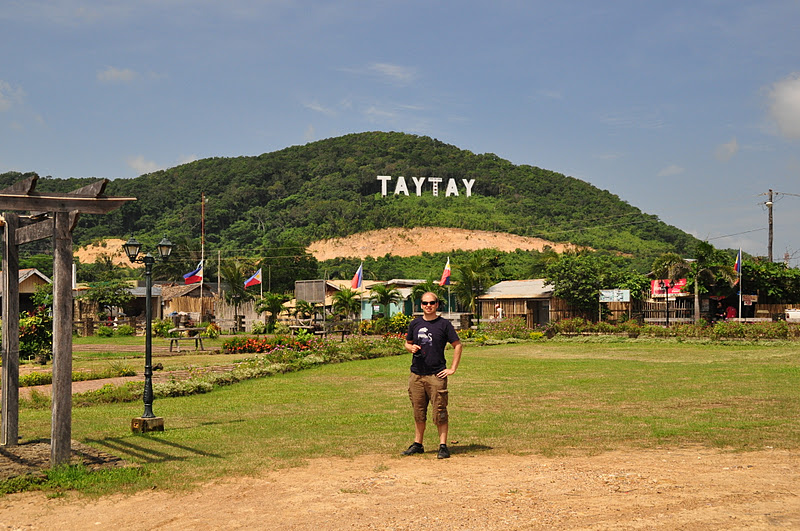
We made a brief stop in Taytay. From Taytay, you can also make some island hopping. While Roxas was pretty simple and laid back, Taytay appears to be more touristy.

While the road from Puerto Princesa to Taytay was already in an excellent condition, the asphalted road ended there. Between Taytay and El Nido, the road was paved on some parts or on just on one side, but mostly it was only the old dirt road from some 15 years ago. There were still some potholes and pits.